Friday, November 20, 2015

Storytelling: Léolo

"Awaking from the kingdom of dreams is brutal. I'm an early riser."
Leo Lauzon

I recently visited Niagara Falls & Toronto and thought that it would be cool to do a post on a Canadian-made film. It was going to be The Sweet Hereafter, but since it takes place in a fictional New York community, I decided to go for a more locally-flavoured film...which is why I landed on Léolo. Spoilers: this movie is CRAZY. Like, legitimately coo-coo banana pants. Made in 1992 by writer/director Jean-Claude Lauzon (the Frenchiest of French-Canadian names!), the story centers around Leo Lauzon: a young, linguistically talented boy living in the "squalid Montreal tenement" of Mile End with his lunatic family. The film deals largely with escapism and the thinly etched border between genius and insanity. That sounds all well and good, sure, but the directorial choices and narrative decisions make Léolo one bizarre tale.

No official rating, so I recommend 'R' as it contains plenty of adult material.

To deal with his family and their less-than-sane tendencies, Leo places himself into a fiction of his own creation. In it, he is the son of an Italian tomato farmer rather than a working-class industrialist who obsesses over bowel movements; he is a deep-sea treasure hunter instead of the victim of an attempted drowning at the hands of his grandfather; he is brother to an insectile queen, not a little girl fascinated with bugs. Leo—or, as he prefers to be called, Léolo—writes down all of his adventures before crumpling them up and tossing them away. They are all inevitably retrieved by the 'Word Tamer', i.e., an elderly acquaintance who the young boy rather tellingly sees as a reincarnated Don Quixote. In reality, Word Tamer is little more than an innocent voyeur who collects people's trash, reads their letters, and looks at their photographs in order to 'keep them alive' before burning the remains.

Despite his polluted genes, Léolo does not see himself as insane. Rather, he distances himself from his family and uses his written words as a sort of soft cushion between his understanding of the world and its grim realities. He wishes to be in a different place, so he puts himself there in his mind's eye. For example, whenever the object of his boyish desire—beautiful neighbor Bianca—sings, he imagines a door opening into a sunny Italian city. He is able to experience this metaphysical transportation, too, whenever he scribbles down his thoughts...though, as time goes on, he finds the act more and more difficult to achieve as he runs into the insurmountable dilemma of diminishing returns.

Looking out onto an imagined landscape of Tuscan villas.

Sometimes the audience is not kept abreast of when the story takes a turn toward the theoretical. In once instance, the narrator tells us that "My family had become characters in a fiction," and later proceeds to relate how his older brother, Fernand, changed from a scrawny, bullied kid into a muscle-builder. This transformation does actually take place (maybe) and occurs in a single revolving shot, showing Fernand working out with weights before magically turning into a suspiciously uncanny lookalike of the model on the cover of his prized fitness magazines. It is entirely possible that this all has to do with perception, since Léolo wants to believe that "So tall I will be on my brother's shoulders." The strength aspect is purely physical, though, as Fernand is much too cowardly to take on his bully even with the added brawn. It is at this point that Léolo's admiration for his brother extinguishes. This in turn makes it more difficult for him to place faith in his own stories.

Another reason as to why the audience should be
slightly incredulous concerning Fernand's sudden beefiness:
Léolo does not visibly age from the beginning to the end of the metamorphosis.

As Léolo's life starts to take its toll and—as mentioned earlier—he can no longer easily meet the solitude of his dreams, things begin to take a dark turn. No one knows about his talent apart from the Word Tamer who tries to advocate for the child by talking to his teachers (alas, to no avail). Limited by circumstance and blaming his sick grandfather for his fate, little Léolo tries to assuage his frustration by attempting to murder the old man. Things...backfire. Understandably, the boy's number one fear is being placed in the institution where nearly all of his family member are forced to reside, so he begins to contemplate a more fitting end.

Being a kid is confusing enough without having to deal with a turkey in the bathtub, so Léolo's decision to commit suicide makes a certain amount of sense. Disagree? Listen: One day when he was helping his brother collect recyclables to sell at the local plant, Léolo stumbled across a broken record. He knew it would never play again, but he kept it anyway because he loved the image on the sleeve. Later, toward the end of his life, he finds a sliver of record that perfectly matches the missing chunk. Finally, he would be able to hear the music—to make the record whole. Only...no, he couldn't. Even though he had all the parts, the object had still been broken beyond repair. He could not very well glue something like that back into place and expect it to work just like new. It was already too late. [Obvious metaphor is obvious.]

Léolo occupies the scene of the crime in a last-ditch attempt to climb his way out of his life.

Jeez. That's dark. Maybe there is a happier ending, though. Léolo's nightmare is realized when he fails to kill himself, instead simply going into a catatonic state and winding up as a vegetable in the sanitorium. "Fuck me sideways, Rachel! That's not any bloody happier!" Hmm, well, maybe not based solely upon outward appearances. Léolo has a mantra: "Because I dream, I am not." This is based on L'Avalée des avalés by Quebec-based playwright/novelist Réjean Ducharme, who is best known for early works that involve themes relating to the "rejection of the adult world by children." In the film, Léolo stumbles across a copy of 'The Swallower Swallowed' and forms a fixation upon it despite the fact that the words reach well beyond his level of comprehension. With this in mind, it cannot be too far fetched to imagine that Léolo is able to achieve peace when locked inside his own mind. Without any awareness of the mad world around him he is free to explore the annals of his unconscious being. It's better than being dead, in some views.

The Word Tamer left his copy of the book at Léolo's home, unwittingly affecting the boy's future.

For further information:

Tuesday, October 20, 2015

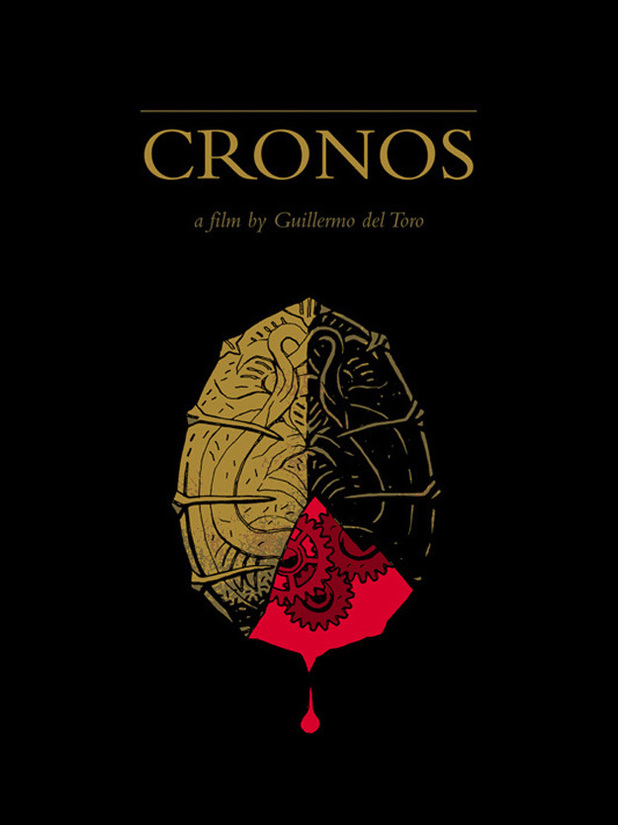
Mythology in Movies: Cronos

It's October, and we all know what that means—☠ spook-tacular ☠ moooooovies! (Ugh. No. That is awful. Let's forget I just used that term and move on.)

Man oh man! *slaps knee* Can you believe that it's been an entire year since this post on The Devil's Backbone? Whew! Where did the time go? That's actually a fairly pertinent question given this post's topic: Guillermo del Toro's Cronos, or, more specifically, imagery in the film that symbolizes time and what that has to do with myth-telling. The story friggin' starts with a chiming clock and leads into an XCU of grinding gears so, yeah, I would say we've got a solid base.

[Schpoilerz.]

Rated R for horror violence and for language.

What's in a name? (I'm in the mood for terribly clichéd phrases today. Hopefully it passes.) 'Cronos', also spelled as 'Chronos' from the Greek, is the ancient philosophical personification of time. He is usually portrayed as an old man with a beard. This description parallels that of lead character Jesus Gris (Federico Luppi, Dr. Casares in TDB), who is an elderly antique dealer with a 'stache white as snow (nope—still clichén' it up in here). In some creation myths, the god and his serpent companion circled the world egg with their coils, cracking it apart to form a more orderly form of the universe. Also of note is that, according Orphism, Chronos is said to have produced a big, silvery egg in the Aether. From this egg emerged Phanes, the deity of procreation who made the cosmos and birthed all first gen. gods. No biggie. I bring this up because eggs are another symbol closely tied to time in Cronos.

Eggs in little silver holders can be seen on the fridge door.
The white bandage around Gris's hand is held together with similar silver clips.

We've got good ol' Father Time. We've got eggs with shiny bits. We've got a dressed hand that was recently bloodied by the Cronos device, which is itself a sort of egg containing a weird...bug...thing. What is going to emerge from Gris's injury? His lust for life, it would seem. Some things remain unclear—ambiguity is something viewers love in Del Toro's works. Is Gris actually transformed into a vampire, or is he is some other kind of undead creature? One thing is definitely apparent, though: the dude needs blood to survive. Luckily for him, De la Guardia and his nephew Angel provide more than enough of the sanguineous stuff.

Put that last thought on hold for a sec, because the lesson in allegorical theory isn't over yet. (Trust me, it will all tie together. Just hang in there.) Chronos is oftentimes confused with the Greek Titan Cronus/Kronos, though—today—some argue that the two were once thought to be one in the same. At any rate, "Cronus represented the destructive ravages of time which consumed all things," something which is made obvious by the consumption of his children (the young being ravaged by the old, for those failing to grasp the metaphorical implication). In the film, Angel loathes his uncle and eventually deals the life-sucking scoundrel the killing blow, saying, "You've made me wait long enough." I posit that this mimics the Olympians overthrowing their father during the Titanomachy. Once freed from his stomach by their brother Zeus, they all took Cronus down much like he did his own father. In most versions, his is an unhappy fate.

See? We got through it. Together! ;-)

Further 'proof' that the two gods are actually one lies in Cronus' main symbols, namely the sickle and the scythe. Father Time—whom I mentioned earlier—is inextricably bound to Death, and both are usually pictured with a reaping tool. Our concept of Papa Past-Present-Future stems from none other than Chronos.

Gris passes behind some dude dressed up as a clock at a New Year's Eve party.
Subtility is for chumps, right Del Toro?

Almost all portrayals of immortality in both age-old fables and modern-day fiction are pessimistic. Sure, it sounds great in the short-run: you never die and—usually—get to stay young forever. The catch? Everyone around you fades away. They grow old while you are forced to watch them and the rest of the world wither away into nothingness. If you're a vampire or something similar, you might have a coven (Underworld) or a biker gang (The Lost Boys) or even some schoolgirls to take as possum-eating brides (The Monster Squad), but you've still got to drink the blood of others to survive, and that kinda sucks (bad puns as well as clichés, yikes). If you're a zombie, you're not really you so much as brain-dead. Angels are tossers, demons don't have souls, and...hey! A lot of these guys can actually be killed, be it with wooden stakes, machetes, exorcism, et cetera. Point being, immortality is not all it's cracked up to be. Del Toro's take on it in Cronos is no exception. There is something organic powering the Cronos device just as humans are living, breathing time bombs. You can keep things ticking only for so long before the consequences begin to outweigh the benefits.

Yeah, you can live forever, but what kind of existence would that be?
No one wants to live like organ-missing, drug-pumped De la Gaurdia in his isolated factory.

Back to eggs for a moment...there are some crazy things out there about egg myths. One I remember in particular has to do with the French folktale Bluebeard by one of this blog's favourite authors, Charles Perrault! If you want a nice (and humorous) summarization of the story, check out fable expert Dael Kingsmill's Bloody Bluebeard video on YouTube that she posted last Halloween. Anyway, toward the end of a variation of the story called Fitcher's Bird, big bad Bluebeard tells his wife never to go into this one particular room in their castle. Before he goes on some errand or another, he gives her an egg to hold onto whilst he's away. Seems like a dandy request, so she agrees to carry it around. Once he leaves, she of course enters the forbidden chamber, and what she sees inside shocks her so much that she drops the egg onto the floor. It gets completely coated in blood. Insert somewhat tired observation about the whiteness of eggs representing virginity and how the blood in turn symbolizes a break from said purity, blah blah blah blah...oh! Look! A screencap from Cronos highlighting my point in a slightly-vague-though-not-totally-far-fetched way!

The marble floor looks like a cracked egg, you say?
Why yes...yes it does, doesn't it?
You could say the same of Gris's second skin, all soft and the colour of alabaster.
Coincidence...?

Perrault seems to have influenced Del Toro on more than just one flick. Gris's granddaughter, Aurora (Tamara Shanath), is oftentimes seen wearing red clothing (her rain jacket even has a red hood). Given that she is Miss Creepy McCreepster, I am definitely not as convinced of her innocence as I am of Little Red Riding Hood's...but she is still a child and the driving force behind Gris's grisly actions. Del Toro would certainly want to draw attention to these facts, and did so—at least in part—through very deliberate choices in costume design.

Possibly the most psychologically scarred little girl on the planet.

This onion just keeps on a'peelin', but I will draw this post to a close. Viewing Del Toro's fairy tale/horror trilogy last to first was a grand adventure; it is one that will continue to give me nightmares for years to come. *cough*paleman*cough* Hopefully you learned something new from this jumble—feel free to leave a comment if you have any insights to share! Happy Halloween, and suo tempore.

Gris falls from grace in front of a giant clock face. *whispers* Suuuuubtleeeetyyy!

For further information:

Sunday, September 20, 2015

Foreign v. Hollywood: Memoirs of a Geisha

My friend Maggie leant me her copy of Memoirs of a Geisha a couple of months ago—a book I have been looking forward to reading since a guest presenter gave a lecture on geisha for a Japan-centric HUM course during my final semester at Alverno. What sparked my interest was that, while it is a historical novel based on research and interviews, MoaG is also a work of fiction written by an American author (Arthur Golden).

The presenter was a little vague about why he personally did not like this particular work, but he did make it clear that "geisha are performers, not prostitutes." Consider my interest piqued. I had very little previous knowledge of geisha—or even of Japan during & after the Meiji period—but neither had I thought to equate them with workers in the sex industry. It was then that I added MoaG to my summer reading list and have since found that it is a well-written story that offers some accurate historical insight into the lifestyle of geisha during the early to mid-1900s despite the fact that it is written from a western perspective.

This is not a book review, though. No matter my feelings about the novel's (albeit somewhat limited) usefulness in the understanding and analysis of a foreign social culture—or indeed the many challenges made to particular 'creative' assertions made by Golden after his work was published—the movie needs to be seen in its own light. My major reason? Memoirs of a Geisha is an American movie, filmed mostly on American soil using Hollywood sets. It was based on an American screenplay which was then shot by an American director and produced by a bunch of, you guessed it: Americans. Also, for whatever reason, the casting crew thought that it was a brilliant idea to have Chinese actresses take on the three lead female roles. Like nobody would notice. 'murica.

Does that mean it is not worth anybody's time to watch? Surprisingly, no.

Rated PG-13 for mature subject matter and some sexual content.

There are a few differences between the book and the film, as always. For instance, the latter did not go in-depth into Chiyo's childhood, the loss of her virginity/mizuage, or the immediate aftermath of the Baron's molestation. Also, Chiyo's transformation into a full-blown geisha was literally montage'd. Apart from those things (and a lot of skimming through Japanese history and tradition not directly related to geisha), the film did a fairly decent job relating the original story. Still, keep in mind that this is Hollywood, where things are made to look both glitzy and sensational. America is rather odd when it comes to censorship, i.e., violence generally seems to be okay while nudity and sex—the tasteful variety—have been viewed with negative bias until more recent years.

As I just mentioned, certain scenes of a more sexual nature were glossed over completely on-screen. This is definitely not so in the book where geisha like Hatsumomo are made to look promiscuous, and Sayuri is instructed to put her body on offer should she or her onesan deem it necessary. In the movie, Hatsumomo's liaisons with the local lads are made to look a bit more heartwarming ("She loved once. She hoped once.") and Sayuri is shown as a victim of her circumstances—perhaps justly so—rather than as an engaged player. Her written counterpart, however, comes off as being a bit more wise to the world and is less at the mercy of the men in her life due to long-term scheming and subtle emotional manipulation. 

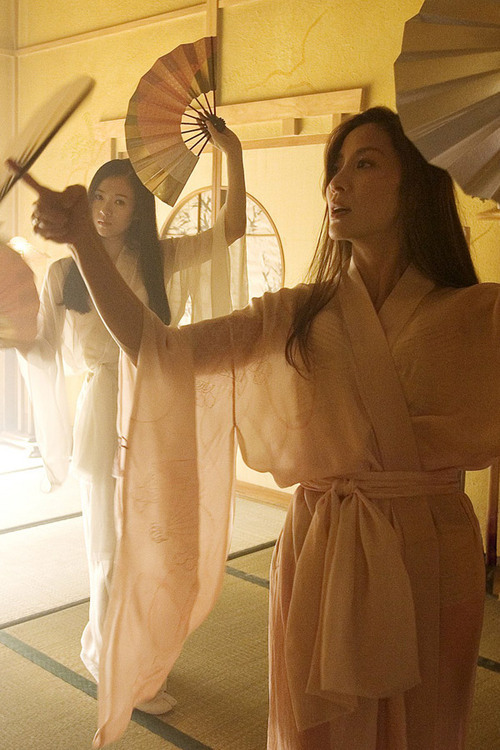
Mameha teaching Chiyo/Sayuri a traditional fan dance.

There is obviously more to the movie than how it differentiates from the novel. It is important to look at the accuracy of both given their popularity, meaning that they "likely shaped western perspectives." Also note, however, that the film especially can be useful as a teaching tool because it reached such a wide audience—likely one much larger than the book's readership. Such works obviously have to be viewed with caution, as they are often confined to showing a single perspective and sometimes have to leave out out important contextual material. All the same, I personally found it helpful to view the film. Coming from the U.S., it was challenging to picture a few things mentioned in the the book, such as time-honoured tea ceremonies, ritualistic dances, foreign musical instruments, et cetera. (This was after I had already taken several courses in Eastern culture throughout my academic career.) Coming equipped to see this film with some background information and a general understanding of the impact of global perspectives, I felt secure in my appreciation of what MoaG had to offer.

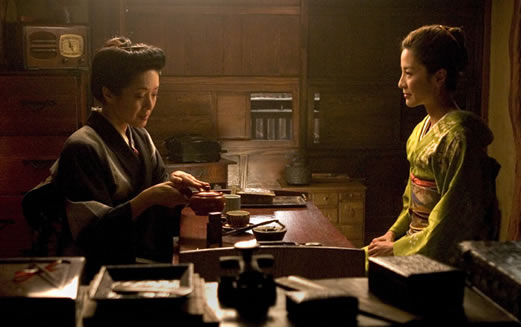
Mother and Mameha discussing business over tea.

In the end, so long as the audience is armed with some preliminary info. about Japanese culture around the time of WWII and can figure out that one movie does not represent the singular truth (esp. when it is a fictive autobiography), then there is no reason as to why MoaG cannot be an advantageous viewing experience. Unfortunately, the above criteria is not usually taken into account, as it is rare that people go out to the cinema for its historical acuity. Even then, though, MoaG is not so blatantly wrong that viewers going in with absolutely no familiarity with the subject matter would be somehow irrevocably mislead or 'damaged' by watching it. All told, the film features an impactful story with some beautiful choices in direction (dance scene, Imma lookin' at'choo!). It gets a solid recommendation from this viewer.

For further information:

Wednesday, August 19, 2015

Colour & Mixed Media: Hector and the Search for Happiness

Based on French novelist François Lelord's work entitled Le voyage d'Hector ou la recherche de bonheur, this film follows the life of an unfulfilled psychiatrist as he travels the world (well, a few countries) in search ofyou guessed ithappiness. While I am a huge fan of Simon Pegg (who takes on the titular lead), the story itself lacks a lasting emotional impact while the characters are stereotypical to the point of distraction. The latter qualm could be explained away via an argument for the 'clever' incorporation of archetypes, but such a move—if even it was the intention—simply did not hit home. The entire thing felt a bit too much like a whimsical version of Eat, Pray, Love...a novel which I detest absolutely...so that obviously did not improve my estimation. Still, as with any movie, this one has its merits. The usage of colour caught my attention from the very beginning when the opening shot displays a bright yellow bi-plane soaring through a sky filled with puffy, white clouds. This plane represents happiness in its purest form and, as various forces bring the plane down, so too do obstacles get in the way of Hector's ability to achieve that dream.

"Yellow...[is] associated with joy, happiness, intellect, and energy."
Color Wheel Pro

A photograph of Hector hugging his ex-girlfriend, Agnes (Toni Collette).
Agnes wears yellow; Hector believes that she is his only true source of happiness.

Hector sits opposite his current girlfriend, Clara (Rosamund Pike).
The vase of yellow flowers acts as a barrier between them.

A yellow train passes through a town someplace in Africa,
a place the film paints as shot through with only transient moments of happiness.

As I kept note of other instances of yellow when watching Hector and the Search for Happiness, I also noticed the periodic injections of mixed mediasomething which was more than welcome given the combination of the storybook theme and the part played by the art journal Hector uses to track his progress.

Hector leaves a Buddhist temple in China.
The dog—a dead pet—crops up from time to time...the symbolism is a tad vague.

Lots of plane trips!
I'd probably be happier if I could afford to fly off to multiple continents on a whim. -_-

Cute lil' globe-trotter, a home movie, and a purposefully crude collage.
(Yes, I now possess the power to gif. Mwahaha!)

Much like the home movie effect in the previous image,
this screencap displays a decoupage filter that gives off an air of nostalgia.

Line art of Hector's 'dog of the mind'. Beatific. :P

OK, so the movie wasn't terrible. The art director saved it by introducing a few elements of visual creativity that serve to capture the audience's attention long enough to carry them scene-to-scene. Still, I cannot recommend HatSfH in good conscience, even with my limitless love for Pegg. Sorry, bae. </3