Sunday, September 20, 2015

Foreign v. Hollywood: Memoirs of a Geisha

My friend Maggie leant me her copy of Memoirs of a Geisha a couple of months ago—a book I have been looking forward to reading since a guest presenter gave a lecture on geisha for a Japan-centric HUM course during my final semester at Alverno. What sparked my interest was that, while it is a historical novel based on research and interviews, MoaG is also a work of fiction written by an American author (Arthur Golden).

The presenter was a little vague about why he personally did not like this particular work, but he did make it clear that "geisha are performers, not prostitutes." Consider my interest piqued. I had very little previous knowledge of geisha—or even of Japan during & after the Meiji period—but neither had I thought to equate them with workers in the sex industry. It was then that I added MoaG to my summer reading list and have since found that it is a well-written story that offers some accurate historical insight into the lifestyle of geisha during the early to mid-1900s despite the fact that it is written from a western perspective.

This is not a book review, though. No matter my feelings about the novel's (albeit somewhat limited) usefulness in the understanding and analysis of a foreign social culture—or indeed the many challenges made to particular 'creative' assertions made by Golden after his work was published—the movie needs to be seen in its own light. My major reason? Memoirs of a Geisha is an American movie, filmed mostly on American soil using Hollywood sets. It was based on an American screenplay which was then shot by an American director and produced by a bunch of, you guessed it: Americans. Also, for whatever reason, the casting crew thought that it was a brilliant idea to have Chinese actresses take on the three lead female roles. Like nobody would notice. 'murica.

Does that mean it is not worth anybody's time to watch? Surprisingly, no.

Rated PG-13 for mature subject matter and some sexual content.

There are a few differences between the book and the film, as always. For instance, the latter did not go in-depth into Chiyo's childhood, the loss of her virginity/mizuage, or the immediate aftermath of the Baron's molestation. Also, Chiyo's transformation into a full-blown geisha was literally montage'd. Apart from those things (and a lot of skimming through Japanese history and tradition not directly related to geisha), the film did a fairly decent job relating the original story. Still, keep in mind that this is Hollywood, where things are made to look both glitzy and sensational. America is rather odd when it comes to censorship, i.e., violence generally seems to be okay while nudity and sex—the tasteful variety—have been viewed with negative bias until more recent years.

As I just mentioned, certain scenes of a more sexual nature were glossed over completely on-screen. This is definitely not so in the book where geisha like Hatsumomo are made to look promiscuous, and Sayuri is instructed to put her body on offer should she or her onesan deem it necessary. In the movie, Hatsumomo's liaisons with the local lads are made to look a bit more heartwarming ("She loved once. She hoped once.") and Sayuri is shown as a victim of her circumstances—perhaps justly so—rather than as an engaged player. Her written counterpart, however, comes off as being a bit more wise to the world and is less at the mercy of the men in her life due to long-term scheming and subtle emotional manipulation. 
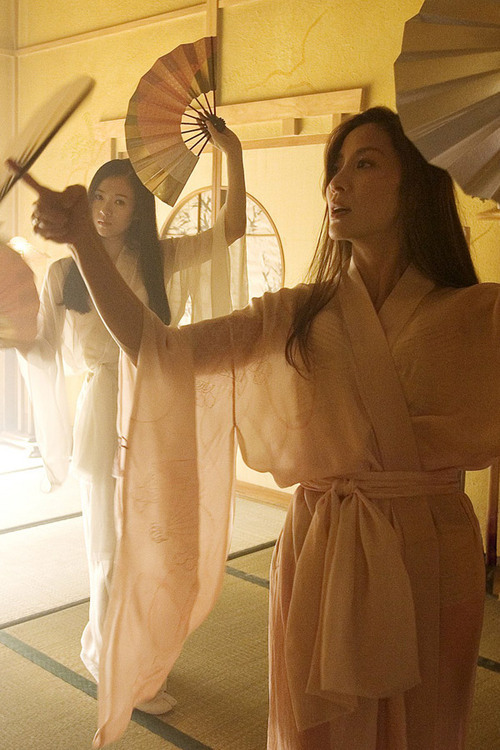
Mameha teaching Chiyo/Sayuri a traditional fan dance.

There is obviously more to the movie than how it differentiates from the novel. It is important to look at the accuracy of both given their popularity, meaning that they "likely shaped western perspectives." Also note, however, that the film especially can be useful as a teaching tool because it reached such a wide audience—likely one much larger than the book's readership. Such works obviously have to be viewed with caution, as they are often confined to showing a single perspective and sometimes have to leave out out important contextual material. All the same, I personally found it helpful to view the film. Coming from the U.S., it was challenging to picture a few things mentioned in the the book, such as time-honoured tea ceremonies, ritualistic dances, foreign musical instruments, et cetera. (This was after I had already taken several courses in Eastern culture throughout my academic career.) Coming equipped to see this film with some background information and a general understanding of the impact of global perspectives, I felt secure in my appreciation of what MoaG had to offer.
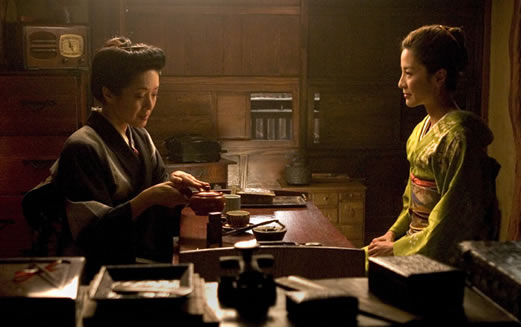
Mother and Mameha discussing business over tea.

In the end, so long as the audience is armed with some preliminary info. about Japanese culture around the time of WWII and can figure out that one movie does not represent the singular truth (esp. when it is a fictive autobiography), then there is no reason as to why MoaG cannot be an advantageous viewing experience. Unfortunately, the above criteria is not usually taken into account, as it is rare that people go out to the cinema for its historical acuity. Even then, though, MoaG is not so blatantly wrong that viewers going in with absolutely no familiarity with the subject matter would be somehow irrevocably mislead or 'damaged' by watching it. All told, the film features an impactful story with some beautiful choices in direction (dance scene, Imma lookin' at'choo!). It gets a solid recommendation from this viewer.

For further information:

Wednesday, August 19, 2015

Colour & Mixed Media: Hector and the Search for Happiness

Based on French novelist François Lelord's work entitled Le voyage d'Hector ou la recherche de bonheur, this film follows the life of an unfulfilled psychiatrist as he travels the world (well, a few countries) in search ofyou guessed ithappiness. While I am a huge fan of Simon Pegg (who takes on the titular lead), the story itself lacks a lasting emotional impact while the characters are stereotypical to the point of distraction. The latter qualm could be explained away via an argument for the 'clever' incorporation of archetypes, but such a move—if even it was the intention—simply did not hit home. The entire thing felt a bit too much like a whimsical version of Eat, Pray, Love...a novel which I detest absolutely...so that obviously did not improve my estimation. Still, as with any movie, this one has its merits. The usage of colour caught my attention from the very beginning when the opening shot displays a bright yellow bi-plane soaring through a sky filled with puffy, white clouds. This plane represents happiness in its purest form and, as various forces bring the plane down, so too do obstacles get in the way of Hector's ability to achieve that dream.

"Yellow...[is] associated with joy, happiness, intellect, and energy."
Color Wheel Pro

A photograph of Hector hugging his ex-girlfriend, Agnes (Toni Collette).
Agnes wears yellow; Hector believes that she is his only true source of happiness.

Hector sits opposite his current girlfriend, Clara (Rosamund Pike).
The vase of yellow flowers acts as a barrier between them.

A yellow train passes through a town someplace in Africa,
a place the film paints as shot through with only transient moments of happiness.

As I kept note of other instances of yellow when watching Hector and the Search for Happiness, I also noticed the periodic injections of mixed mediasomething which was more than welcome given the combination of the storybook theme and the part played by the art journal Hector uses to track his progress.

Hector leaves a Buddhist temple in China.
The dog—a dead pet—crops up from time to time...the symbolism is a tad vague.

Lots of plane trips!
I'd probably be happier if I could afford to fly off to multiple continents on a whim. -_-

Cute lil' globe-trotter, a home movie, and a purposefully crude collage.
(Yes, I now possess the power to gif. Mwahaha!)

Much like the home movie effect in the previous image,
this screencap displays a decoupage filter that gives off an air of nostalgia.

Line art of Hector's 'dog of the mind'. Beatific. :P

OK, so the movie wasn't terrible. The art director saved it by introducing a few elements of visual creativity that serve to capture the audience's attention long enough to carry them scene-to-scene. Still, I cannot recommend HatSfH in good conscience, even with my limitless love for Pegg. Sorry, bae. </3

Friday, July 10, 2015

Coming soon...

Keep an eye out for these future posts!

July 2015: I'm taking a vacation!
The first since I started this blog. ;-)
Real-life work is a bit hectic, so I thought it was a good month to go on a short hiatus.
See you in August!


August 2015: Hector and the Search for Happiness


September 2015: Memoirs of a Geisha


October 2015: Cronos


November 2015: open to suggestions

Saturday, June 20, 2015

Costuming & Makeup: Nosferatu

Nosferatu, eine Symphonie des Grauens (or, Nosferatu, a Symphony of Horror) was a silent horror film made by German director F.W. Murnau in 1922. Based on Bram Stoker's Dracula, the story goes as follows: This creepy, bald antagonist named Count Orlok is kind of moping about the place with his, ahem, 'interesting' fashion sense and overly long, talon-like fingers when he decides to get his stalk on for Ellen, the wife of real estate agent Hutter. Not cool, dude. Hutter was just trying to secure a home for yo' pasty white ass and you had the gall to be all up on his girl like the blood-sucking, undead vampire you are. -_- What a dude.

Clearly, Orlok photographs just as beautifully as I do.

To portray such a vile creature, producer/production designer Albin Grau had his work cut out for him...or did he? According to one (albeit unknown) source, Max Shreck—the actor who portrayed Nosferatu—had an "innate gaunt and emaciated frame...[he] has the suitably hungry and predatory appearance that one might expect of a vampire." While Grau was the one to dream up the elongated fingers and popping eyes, back in the day most silent film actors had to apply their own makeup. It is possible that Shreck himself placed his own bald cap, applied putty around the nose, added ear extensions and fangs, used spirit gum to incorporate tufts of hair around gangly eyebrows, and utilized grease paint to give himself a deathly pale sheen.

"You raaaaaang...?"

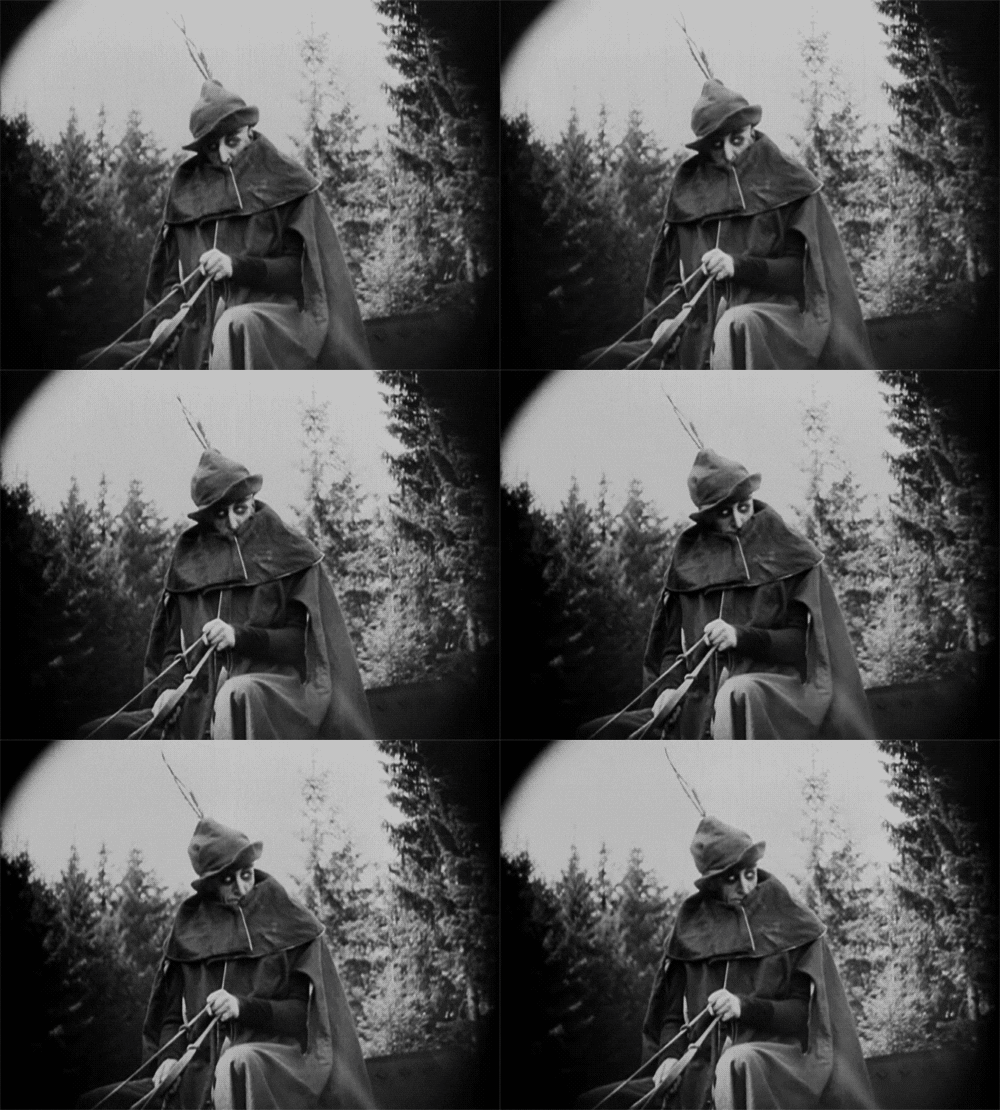
Costuming is also important, especially since visual elements mean so much in silent films; they affect the entire mood of the piece. Orlok is a count, and his fancy coat not only marks his station but lends a certain 'gravedigger-esque' appeal. (It was very in that season, I assure you.) The slightly raised shoulder pads promote a vision of rigor mortis while the buttons down the front are reminiscent of spikes in a coffin. Orlok is also a master of disguise, as evidenced below.

Nailed it.

Ellen, played by gothic beauty Greta Schröder, is also pretty stylin'. Dark ringlets frame her face; an incredibly classical look that, somehow, she manages to pull off without looking anything like Shirly Tample.

Such a sensible hairstyle holds up even on blustery days.

She also displays theatrical makeup, which is understandable given the time period. The most obvious alteration has to do with Schröder's eyes. They look deep—almost like skull cavities—thanks to heavy swaths of eyeshadow. It is a look for which the actress is well known even to this day.

The fainting femme dressed in virginal white, as per usual.

Do not think for one moment that such a shrinking violet could hope to steal the fashion show, though: Orlok is the trend-setter who can rock a ruffled turban, after all.

Orlokalways one to appreciate an ascotrealizes that Hutter is quite the dandy.

I apologize for the somewhat late/rushed post. Google applications have been acting up over the last few days, and I thought of covering Nosferatu only recently after a discussion with my friend Michelle. Hope you enjoyed it all the same! ^,.,^


For more information: