Eva Green as the enigmatic Miss G. Backlit by a grey, clouded sky that emphasizes her solitude.
Miss G again on her own, this time at the gates of the boarding school. Little to no lighting gives strength to the atmospherically rainy weather.
Click-clacking her heels between the pews, not caring that she is late to the morning's prayer session. Her placement draws attention and lets viewers know just how little this character gives a fuck. A little backlighting from the stained glass windows highlights her intruding presence even more so.
Miss G stands amongst her favoured students. Her placement within the shot separates her from the rest of the group, as they are bathed in light (innocence) while she alone stands in shadow (hidden agenda).
As in the previous shot, the students appear to have a heavenly glow about them. The rest of Miss G's room—untouched by the sun's rays—seems to entrap the girls. Even their uniform frocks subtly blend with the surroundings.
The elite 'circle' of friends caught in one of the rare periods in which they are content with one another. Everything is naturally lit, making the scene a peaceful one as the girls soak up the sun.
Dressed up for their St. Agnes Eve feast. The girls blend their 1930s fashion with flowers reminiscent of Keats' romanticism. This feeling is also aided by the warm, lightly-honeyed lighting.
Renegades skinny-dipping by the light of the moon. The underwater shots in this scene give everything a magical look, especially in contrast with the rest of the film.
A foreigner to England, Fiamma (here played by María Valverde) reads alone in the stables. The light source is opposite, covering her but also creating a shadow along the wall. The symbolism of the barred stalls speaks volumes, too.
Poppy (Imogen Poots) looking through a crack. What she sees is terrible... as viewers are encouraged to think given the dim lighting and the pinpoint reflection in her eye.
If I were forced to describe the film in one sentence or less, I would say that it is a pristine example of that iffy place between being a child and an adult.
Written/directed by Régis Roinsard with a script by Daniel Presely and Romain Compingt, Populaire is an aesthetically pleasing French rom-com about an incredible typist cum inept secretary (Déborah François) and her determined-to-succeed boss (Romain Duris), the king of mixed signals. Together they enter into a speed typing competition, which were all the rage in the 1950s, apparently. This is a genre that I tend to avoid as it is way overdone in the industry—and therefore has a profusion of reviews out there on the web already—and also because I have a personal dislike for Ye Olde shifty-montage-sex-scene rubbish used in conjunction with boring direction and blatant stereotypes in both the plot and dialogue. That being said...I enjoyed the hell out of this movie. It was adorable, and fluffy stuff in controlled doses can be quite nice. Plus, seeing the charismatic Bérénice Bejo again (whom some of you may remember from my post on The Artist) was a real treat.
Anyhow, I have been meaning to pay homage to inventive title sequences for a while now, and Populaire has given me the perfect opportunity. While I do not know the actual name/s of the creator/s who put it together, the opening for the film is a thing of beauty. It drops little hints as to who the characters are and what events will transpire throughout the narrative. Unfortunately, there is no sign of it on YouTube or other video sharing sites, so I cannot post it here. In my desperation I've had to settle for screencaps—sorry. The movie streams through Netflix, though, if you have an account and wish to take a look. (You'll probably want to after I tell you that Clive Richardson's "Girl On The Calendar" plays throughout the entire sequence. So uplifting!)
Our leading actors, one of whom portrays a cigarette smoker, the other a secretary in a small office.
The colourful hands are a recurring theme throughout the sequence; a reference to the colour-coated practice keys of a typewriter used within the film.
Dancing, filing, and typing. This particular font aids in the establishment of the story's overall light-hearted feel.
The first and the third screencap in this set have cleverly used vintage magazine cover clippings in keeping with the pastel colours in the middle image. In the actual title sequence, #2 pulls out quickly into #3, placing the viewer into one of the car seats before switching the perspective to that of a pedestrian.
Typeface is an important theme, given that the plot centers around a typewriting competition.
A necklace of typebars: très cool. Note again how the colour of the font is matched with others in the image. There is continuity in the background, as well.
That illustration-to-reality match cut, tho. <3 Gif by me.
So, if you are in the mood for a charming love story with some surprisingly touching scenes and witty discourse reminiscent of the classic silver screen romantics, then Populaire will certainly not disappoint. The chemistry between the leading characters is fresh and, more importantly, one does not really have to care about having to suspend belief in order to enjoy the quirky scenarios as the cinematography, set decoration, costume design et al. makes that act enjoyable rather than a chore.
"Sometimes I wish there was a film crew following my every move. I imagine the camera craning up as I walk away. But, unless things improve, the biopic of my life will only have the budget for a zoom out.*" —Oliver Tate
Thought I would make a return to the blog's original format by doing a post on camera techniques. Submarine was directed by one of my favourite humans on the planet, Richard Ayoade. It was his debut feature-length film, and I must say that the guy knows his stuff. It is always important for directors to avoid lazy filming styles, and Ayoade goes far beyond achieving that goal. Through visuals alone, he quite flawlessly created the feel of every teenager's fear of obscurity and the struggle to create the individual self whilst having to deal with real life situational and relational struggles.
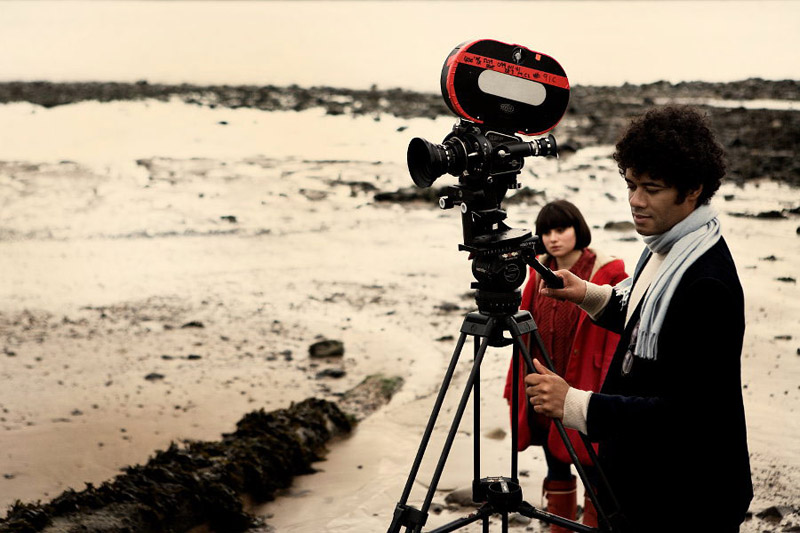
Looking both dapper and professional. Photo cred: The Film Stage
Firstly, I would like to draw attention to Ayoade's use of framing. In this film, at least, he has a tendency toward shooting behind the characters, generally with a medium shot or medium long shot, to create an OTS or third-person shot. This is pretty normal fare but, once the viewer sees it often enough, an intriguing pattern begins to emerge. When the camera stays furtively in the background, the audience effectively occupies the personal space of the characters in shot. Rather than feeling forced or invasive, however, the story simply becomes more intimate. Onlookers experience the scene with the characters by seeing the same things in the distance but are also allowed to exist separately by examining them from the foreground. Colours and lighting are also given special consideration to enhance the execution of this type of scene.
Picspam created par moi.
Ayoade does quite a few unique things with this film, some of which I have never seen before. In the interest of keeping this post from being too lengthy, I have screencapped a number of the more striking visual elements and identified them to the best of my ability. Enjoy!
lens flare and a medium close-up on the profile of Craig Roberts as Oliver Tate
overhead/boom tilt shot at odds with sharp angels within the scene (AKA Dutch angle)
iris in leading to a flashback narrative montage
nostalgia lens with deep focus
in-frame lens with red distortion
point of view shot/reverse angle and kaleidoscope lens
mise en scène perfection
a wonderfully set up left-to-right tracking shot via dolly
purposefully over the top chroma keying
MCU from a parallel side angle, i.e., gorgeous framing
slight overhead shot with carefully laid-out set design
high key lighting (?) and zoom on Yasmin Paige as Jordana Bevan
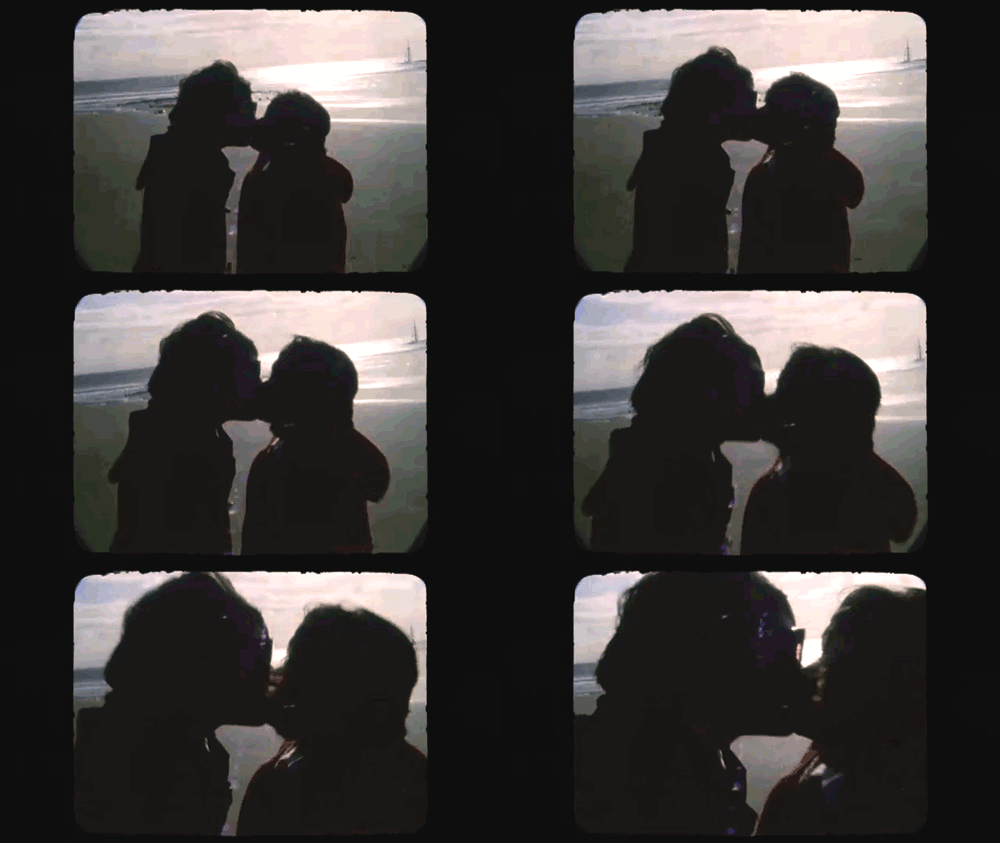
super 8 reel montage
The entire film is rife with compelling cinematic approaches including:
a well-placed freeze frame
instances of shaky cam
the two shot
a rotating camera
subjective camera
a cheeky pull back shot*
multiple cuts between two characters in quick succession
filming via reflection in mirrors + through windows and a fish tank
back-lit bokeh lighting
insertion of title cards
cuts & fades to blue and red
the incorporation of old television footage
the use of silence in contrast with diegetic sound emphasis
non-diegetic narration
and a crap ton of others
If Ayode employs the same amount of attention to detail in his second film The Double, then I will be very excited when it comes out on DVD this August. If you want to see Submarine for yourself—and I recommend that you do—it is available on Netflix and Amazon Instant Video. (It is also based off a book of the same name written by Joe Dunthorne.)
The 2000 film Chocolat, directed by Lasse Hallström, features plenty of myths: the story even begins with 'Once upon a time...'. There's the myth of tranquillité held by the townspeople of Lansquenet-sous-Tannes, holding them back from true happiness. Then there is the myth of Anouk's imaginary, war-injured kangaroo Pantoufle, helping the little girl to cope with moving from place to place alongside her mother as well as with the other children who bully her for living differently. More importantly, I think, is the myth of Vianne's seemingly magical chocolaterie and her Mayan mother, Chitza.
"George was honest, prosperous and trusted by his customers.
But George was not content.
He felt there should be more to life than dispensing liver oil.
In the spring of 1927, the Societe Pharmeceutique formed an expedition to Central America to study the medicinal properties of certain natural compounds.
George was the expedition's most eager volunteer, but his adventure took a turn he did not expect.
One night, he was invited to drink unrefined cacao with a pinch of chilli—the very same drink the ancient Maya used in their sacred ceremonies.
The Maya believed cacao held the power to unlock hidden yearnings and reveal destinies.
And so it was that George first saw Chitza.
Now, George had been raised a good Catholic,
but in his romance with Chitza he was willing to slightly bend the rules of Christian courtship.
The tribal elders tried to warn George about her: she was one of the wanderers.
Her people moved with the North Wind from village to village, dispensing ancient remedies, never settling down.
Not a good choice for a bride.
George did not heed their warning and, for a while, it seemed that he and Chitza might lead a happy life together in France.
Alas, the clever North Wind had other plans.
One morning, George awoke to discover that Chitza and the little girl Vianne had gone away.
Mother and daughter were fated to wander from village to village, dispensing ancient cacao remedies, travelling with the wind...just as Chitza's people had done for generations." —Screenplay by Robert Nelson Jacobs
Interior of La Chocolaterie Maya, decorated with Central American artifacts.
When the North Wind first takes long-time travellers Vianne and Anouk Rocher to the little French town "where everyone knows their place" in the winter of 1959, they are approached with caution and sometimes—in the case of the conservative Comte Reynaud—open hostility. Opening a sweets shop just in time for Lent does not go unnoticed by the Catholic villagers, but Vianne begins to win them over one by one. She and her chocolate help mend relationships, inspire self-confidence, and teach strength to those in need, giving more credence to acceptance, kindness, and happiness than the Comte's harsh sermons ever allowed for. The thought of something exotic is alluring even as Vianne's atheism and Anouk's illegitimacy are brought out into the open by the Comte and the other overly-penitent members of the community. They condemn Vianne as a devilish temptress just as they ostracize a group of river gypsies who dock near the town. Vianne befriends these outcasts, including their Irish captain, Roux (Johnny Depp).
Useless trivia: this is the first & so-far only film in which Depp plays the guitar on-screen.
Thankfully, the chocolate and its 'healing powers' are too strong for some of the townsfolk, allowing the chocolaterie to stay in business. Still, Vianne becomes thoroughly shaken after the death of a friend and an unfortunate incident caused by the town drunk that forces the gypsies to leave and allows the village's traditions to strengthen. She once again begins to feel the pull of the North Wind. Before she can leave, though, her faith in the town is reestablished as her friends flock to her side. Eventually, the Comte himself refuses further self-denial and comes to terms with his own shortcomings. There's a Pagan Easter festival, Vianne decides to stay for good, Roux returns in the summer, and Anouk can let go of Pantoufle. Fin.
This happy ending would not have been possible if it were not for Vianne keeping up the tradition of chocolate-making. The possibility of something new in a town where change is frowned upon turns out to be the catalyst for contentment; not the fabled ideal of tranquillité, but real peace of mind that can only be obtained through self-actualization. Vianne says that she possesses a natural gift for guessing her customer's favourite confections, but what she really sees is the core of a person. This she uses to help them decide what they need in life. The myth of the Mayan wanderers has little to do with magic and all to do with human compassion.
"What do you see?"
As for the film itself, I find it absolutely charming. A lovely movie with winsome characters, touches of magical realism, plenty of romance and, of course, chocolate.