Friday, July 10, 2015

Coming soon...

Keep an eye out for these future posts!

July 2015: I'm taking a vacation!
The first since I started this blog. ;-)
Real-life work is a bit hectic, so I thought it was a good month to go on a short hiatus.
See you in August!


August 2015: Hector and the Search for Happiness


September 2015: Memoirs of a Geisha


October 2015: Cronos


November 2015: open to suggestions

Saturday, June 20, 2015

Costuming & Makeup: Nosferatu

Nosferatu, eine Symphonie des Grauens (or, Nosferatu, a Symphony of Horror) was a silent horror film made by German director F.W. Murnau in 1922. Based on Bram Stoker's Dracula, the story goes as follows: This creepy, bald antagonist named Count Orlok is kind of moping about the place with his, ahem, 'interesting' fashion sense and overly long, talon-like fingers when he decides to get his stalk on for Ellen, the wife of real estate agent Hutter. Not cool, dude. Hutter was just trying to secure a home for yo' pasty white ass and you had the gall to be all up on his girl like the blood-sucking, undead vampire you are. -_- What a dude.

Clearly, Orlok photographs just as beautifully as I do.

To portray such a vile creature, producer/production designer Albin Grau had his work cut out for him...or did he? According to one (albeit unknown) source, Max Shreck—the actor who portrayed Nosferatu—had an "innate gaunt and emaciated frame...[he] has the suitably hungry and predatory appearance that one might expect of a vampire." While Grau was the one to dream up the elongated fingers and popping eyes, back in the day most silent film actors had to apply their own makeup. It is possible that Shreck himself placed his own bald cap, applied putty around the nose, added ear extensions and fangs, used spirit gum to incorporate tufts of hair around gangly eyebrows, and utilized grease paint to give himself a deathly pale sheen.

"You raaaaaang...?"

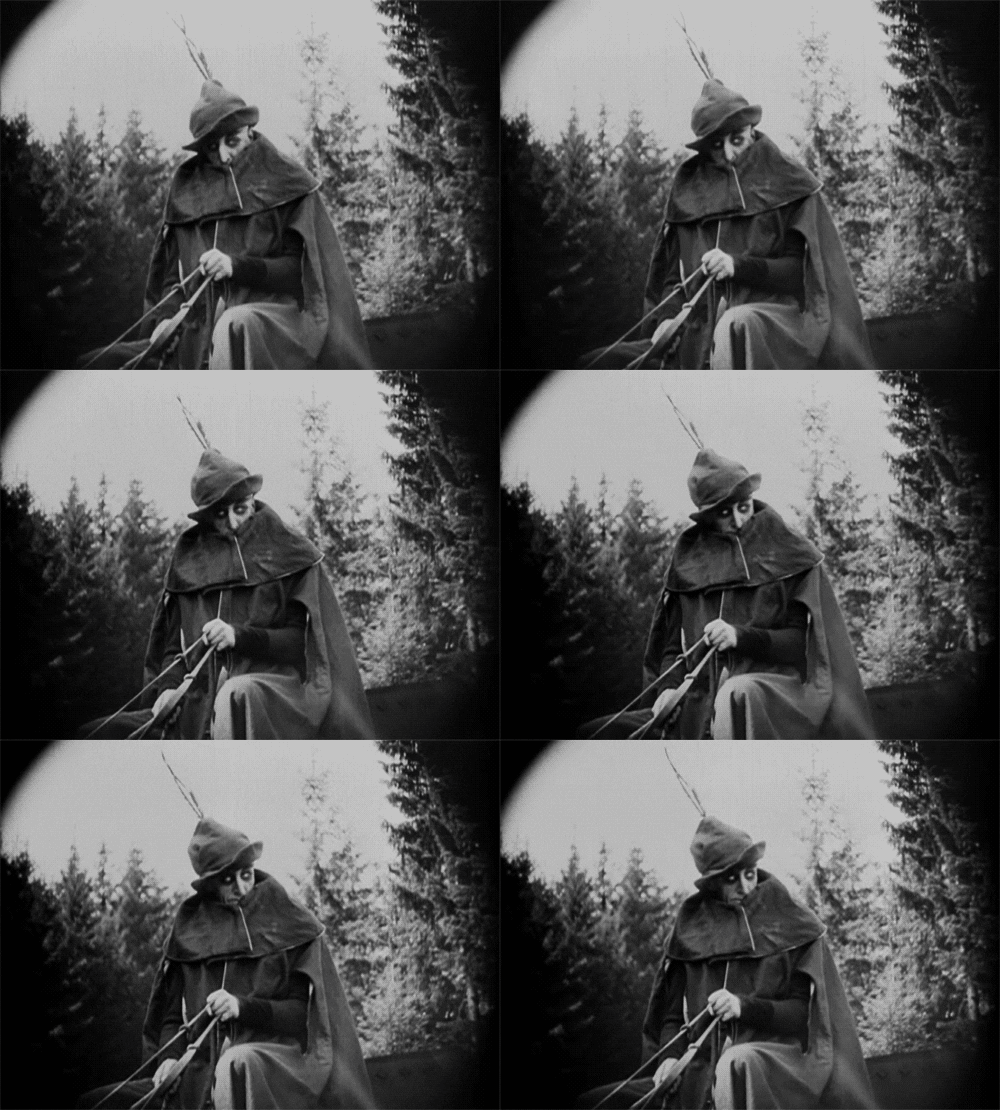
Costuming is also important, especially since visual elements mean so much in silent films; they affect the entire mood of the piece. Orlok is a count, and his fancy coat not only marks his station but lends a certain 'gravedigger-esque' appeal. (It was very in that season, I assure you.) The slightly raised shoulder pads promote a vision of rigor mortis while the buttons down the front are reminiscent of spikes in a coffin. Orlok is also a master of disguise, as evidenced below.

Nailed it.

Ellen, played by gothic beauty Greta Schröder, is also pretty stylin'. Dark ringlets frame her face; an incredibly classical look that, somehow, she manages to pull off without looking anything like Shirly Tample.

Such a sensible hairstyle holds up even on blustery days.

She also displays theatrical makeup, which is understandable given the time period. The most obvious alteration has to do with Schröder's eyes. They look deep—almost like skull cavities—thanks to heavy swaths of eyeshadow. It is a look for which the actress is well known even to this day.

The fainting femme dressed in virginal white, as per usual.

Do not think for one moment that such a shrinking violet could hope to steal the fashion show, though: Orlok is the trend-setter who can rock a ruffled turban, after all.

Orlok—always one to appreciate an ascot—realizes that Hutter is quite the dandy.

I apologize for the somewhat late/rushed post. Google applications have been acting up over the last few days, and I thought of covering Nosferatu only recently after a discussion with my friend Michelle. Hope you enjoyed it all the same! ^,.,^


For more information:

Wednesday, May 20, 2015

Framing: Ida

This 2013 Polish/Danish film directed by Pawel Pawlikowski follows the life of a young, orphaned novice about to take her vows at a convent in the early 1960s. She discovers the existence of an aunt and, together, they go in search of answers concerning what happened to their Jewish family during the Second World War and years of Nazi occupation.

My friend Jackie recommended this film to me a few weeks ago and, since it was on Netflix, I decided to watch it and decide whether or not I wanted to feature it on the blog. From the very first shot of this film I knew that I would have do a piece on framing. Every single scene is set and captured as though they were works of fine art. What follows are some of the best examples of how shot compositions can enhance a story and lend insight into characters and their states of mind. [Heavy spoilers ahead.]

The opening shot of Ida.
The eponymous girl, who originally goes by the name of Anna,
is repairing what appears to be the face of a statue.
It is later revealed to be an effigy of Jesus Christ.

Many scenes are filmed with the subjects placed off-center or in the lower corners of the frame. More on this to follow.

In the first image, Ida helps her sisters erect the statue in front of the convent.
In the second, Ida leaves to join her aunt.

Notice that the statue is far behind the girl as she walks away in the cold.

By drawing focus away from the people in these scenes, Pawlikowski effectively casts aside their importance in the greater scheme of things (in this case, the Christian Church, or God).

Ida is told that she must go and see her aunt before she can take her vows.

She is placed with her back to the door, sitting in contemplation. In another few moments she will stand and leave. Stairs lead up to the door, symbolizing that whatever lies beyond is a place of higher understanding. Still, she must open the door and take the subsequent journey of her own volition.

Wanda Gruz meets her niece.

Bars, chains, and other barriers are a common sight throughout this film. They symbolize different things at different times but, generally, they make apparent a disconnection between people, the world around them, and their understanding of both these things. They can also represent being trapped in the past—in pain.

Wanda watches Ida from the exterior of a bus station,
deciding whether or not she wants to take her back home.

Another wall placed between two characters. This one is familial and generational.

A photograph of Ida as a baby with her mother, Ŕoża.

The shot is askew, the table worn, stained, and dirty. This reflects Wanda's lifestyle just as well as it does Ida's lack of identity.

Before her aunt comes to fetch her back home,
Ida sits by herself on the bus to the station, turned away from her fellow man
as she rides far from her recently discovered past.

Ida stands alone in quite a few scenes.

She resides in a place above others due to her devout nature and holiness, but she is also shut off from them because of it.

Wanda is lonely, too.

The barrier symbolism presents itself over and over again. Here, as Wanda pounds shots at a bar, the old and the new merge in the background (the car v. the horsedrawn wagon). This is another prominent theme in the film. Once known as Red Wanda, the woman worked to rid Poland of 'enemies of the people', AKA anti-socialists. This gave her purpose after the near extinction of her entire family. She is struggling with multiple losses—including her own obsolescence—before Ida even dreams of entering into her life.

The two protagonists are not all that different from one another as they initially believed.

Wanda is framed just perfectly in this shot as it aligns her with the religious piece hanging on the wall. Her similarity to the woman in the painting foreshadows the fact that she is a mother and, perhaps, a woman who once possessed faith in the Almighty.

The two women find comfort in each other's company.

Note the two lamps, the two glasses, and their parallels.

The journey to find the truth, though difficult, is important to both Ida and Wanda.

When the camera is placed to frame a greater portion of the space above the main subjects rather than the subjects themselves, it is possible that Pawlikowski wanted to incorporate the importance of the heavens and their effect on—or, perhaps, their grandeur in comparison to—the people who exist below.

CU on Wanda washing up after she confronts the man whom she believes murdered her son.
A view of extreme grief which the audience is forced to watch up close and personal.

A powerful shot of Feliks, the man who killed Ida and Wanda's family.
He sits in their grave, desiring forgiveness from God.

Wanda walks away, her son's remains in her arms.
Ida stays to collect her parents and discover the final truth of their murder.

The exposed grave lies at her feet just out of shot.

Neither of their faces are shown—in fact, they are cut off from the neck up. The women have succeeded in the mission and, while they are closer because of it, they are also somehow estranged. There exists a chasm between the two of them that is impossible to cross due to the cruelties of the past.

Driving away. From everything.

This is one of the best scenes in the film and is greatly aided by the soundtrack. Wanda drives her car out of the wood where her sister, step-brother, and son were all killed and buried. The path opens up into a field. Sunlight leaks through the branches of trees as the vehicle propels itself forward into the world, an obvious light at the end of the widening tunnel.

After Ida returns to the convent, Wanda jumps from the window of her flat.
The cumulative effect of a life spent in pain.

There are bars above the window; she views it as an escape. The two lamps that were lit when Ida shared the apartment have been switched off.

Ida discovers a new part of herself after everything that has passed.
Perhaps it is not her, though. Rather, it's a reflection of a person she could choose to be.

These frames show the progression of Ida's relationship with Lis, the jazz saxophonist.

She first views him as an outsider, enjoying his world but not taking part. They develop a friendship, but there is still the restriction of her way of life (more symbolic bars, this time as in a cage). When at last a resolution to her parent's deaths is in sight, she begins to open up to the possibility of a more open and romantic relationship with the man (fewer bars with wider gaps surrounded by lights). Be aware that Ida's placement in front of the bars instead of remaining behind them is an important transition.

The recently de-habited Ida listens as Lis plays with his band in a club.

The two lamps are back, possibly signifying the beginning of a new bond.

Ida is a tragic story of identity crisis, fallible faith, personal loss, and cultural devastation, but it also features the strength of familial love, the joys of self discovery, and the importance of closure. I highly recommend watching this artistic drama even if only to appreciate the talents of newcomer Agata Trzebuchowska and veteran actress Agata Kulesza.

For more information:

Monday, April 20, 2015

Foreign v. Hollywood: The Girl with the Dragon Tattoo

Stieg Larsson's Millennium series became quite famous this past decade. His posthumously published works quickly became bestsellers, received many crime thriller awards, aroused public interest in an unfinished manuscript that would allow the series to continue sans ghostwriter, and even spawned a number of silver screen adaptations. Swedish film company Yellow Bird and Danish production agency Nordisk Film co-produced what eventually turned into a six part mini-series back in 2009, bringing all three novels to theaters. The series was majorly successful and was later released as extended editions in trilogy format. Two years later, Yellow Bird partnered with MGM and Columbia Pictures to make an English adaptation of the first book in the series (the other two are still in development).

Rated R for disturbing violent content, sexual material, nudity, and language.
Noomi Repace as Lisbeth Salander (in the forefront).
Michael Nyqvist as Mikael Blomkvist (seated).

So...why remake a set of movies that came out not two years before? Well, money, of course. The Millennium bandwagon is a lucrative one, and having an A-lister like Daniel Craig replace a virtual unknown to US audiences for the lead role of Blomkvist was sure to boost ticket sales and line a lot of pockets in Hollywood. As a fan of the original films, I scoffed at the idea of seeing a glitzy, Americanized version whose creators put out a spoilerific trailer catering to the attention span of a five year old on pixie sticks. Time passed. I decided to blog about the series, so to gain a fuller perspective I forced myself to watch a film which I previously assumed had tanked because the sequels never had a theatrical release. I ended up being surprised.

Rated R for brutal violent content, strong sexuality, graphic nudity, and language.
Rooney Mara as Lisbeth Salander, Daniel Craig as Mikael Blomkvist.
Notice that Craig is in the forefront this time, despite the film's title.

The US version of The Girl with the Dragon Tattoo is purportedly more faithful to the book, though apart from the ending the differences between the two films are very slight. Director David Fincher claims never to have seen the Swedish series, meaning that it is technically not a remake. Having now seen both, I must say that the locations used for Hedestad, Hedeby Island, and even the houses on the island look nearly identical...as does the cinematography. However, the atmosphere definitely has a different feel to it. Despite the longer runtime, the pace of Fincher's film is rushed, somehow making the characters seem less authentic and the mystery not as important as the actual act of bringing the main villain to justice. The use of flashbacks—while just as important to the storyline—lacked some essential clues that were included in the Swedish version. It is my belief that the more recent work is less graphically violent (apart from the scene with the cat) while its sex scenes reveal more nudity. This is surprising, mainly because it is usually the other way around where European-turned-American screenplays are concerned. The relationship between Lisbeth and Mikael is more affectionate in Fincher's interpretation, something which I found difficult to take seriously due to both Lisbeth's history and Mikael's circumstances.

This poster, which sparked some controversy, is unnecessarily hypersexual
and sends the wrong message about the movie and its characters.
Good job, 'murica.

On whole, I actually liked Fincher's version. It was definitely not as effective as Oplev's vision, nor do I understand why it needed to be made in the first place (or why the title sequence is so over the top hardcore and charged with nightmare fuel, or even why everyone's accents are so strange). Nonetheless, it has its own merits—namely its accuracy in following the book and the acting prowess displayed by Rooney and yes, even Craig. Despite the source material, the 2011 movie simply feels Westernized. I cannot pinpoint where it goes wrong exactly, but it somehow fails to capture the grittiness displayed in Scandinavian dramas like The Killing, Wallander, The Bridge, or even Lilyhammer.


Some more posters (click to enlarge).
In the ones above, Lisbeth looks independent and appears to be the main protagonist.
This is not so in the posters below
where again she is sexualized and shown as being only one half of a greater whole,
as though she needs Mikael in order to be 'complete'.
While Mikael is a very important character in the series, these posters serve to make Lisbeth seem secondary in comparison.


For further information: